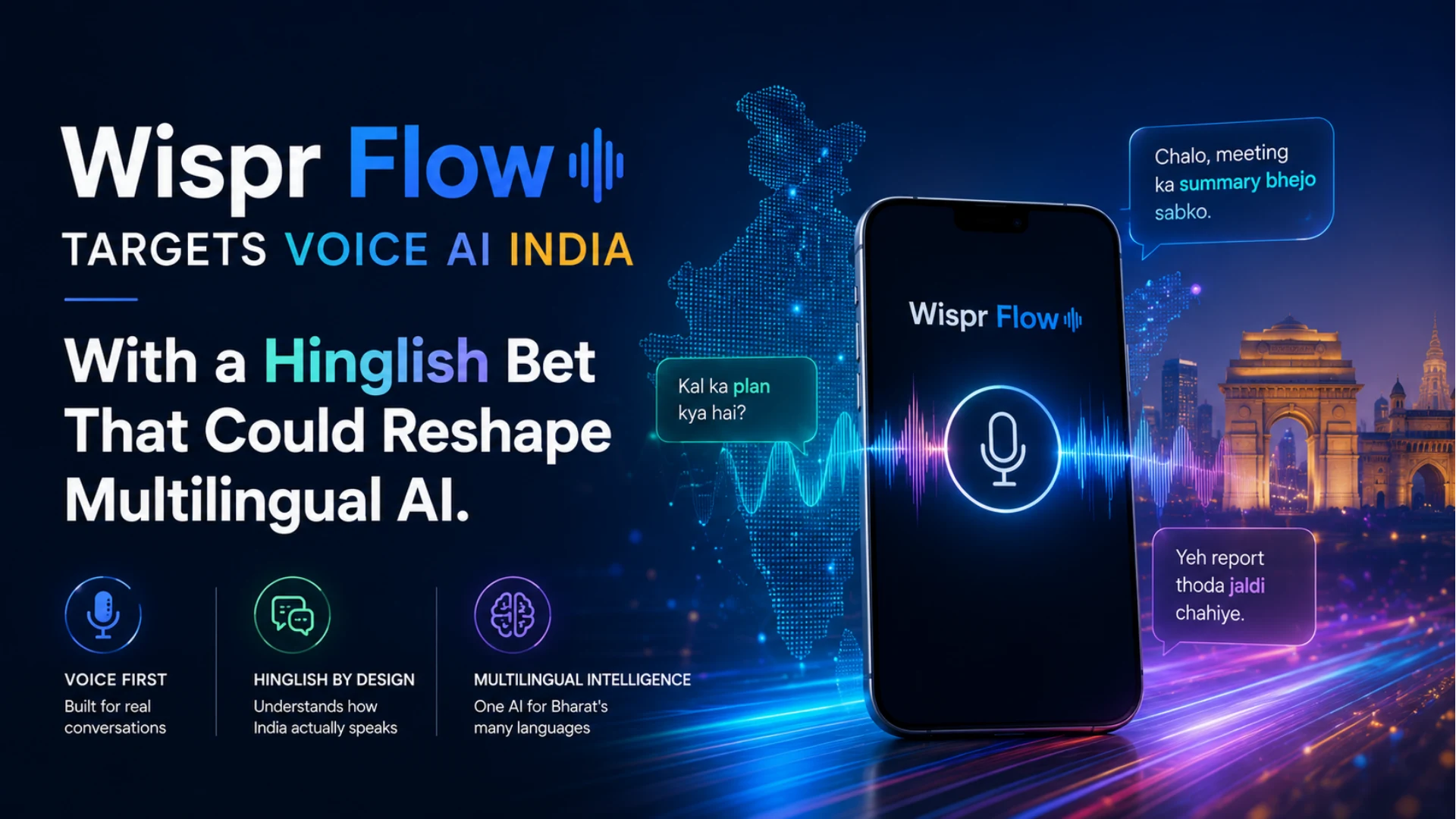
India isn’t just another expansion market on Wispr Flow’s roadmap. It’s a stress test for voice AI India. And how the company handles Hinglish will say more about the future of multilingual voice AI than any benchmark paper ever could.
What Wispr Flow Actually Does — And Why India Is a Big Deal for It
Wispr Flow is an AI-powered voice dictation tool built for speed, accuracy, and professional workflow integration. The pitch is simple: speak naturally, get clean, formatted text output — faster than typing, smarter than basic transcription. It runs across apps, handles punctuation and context, and targets knowledge workers who live in their laptops. [INTERNAL LINK: best AI dictation tools for professionals]
The India push isn’t a passive rollout. It’s a deliberate bet on a specific kind of user: the urban Indian professional who switches languages mid-sentence before they’ve even noticed they’ve done it. That’s not a niche demographic. India has somewhere between 125 and 350 million functional English users depending on how you define the term (Source: British Council — The English Effect in India), and a substantially larger population that operates daily in mixed Hindi-English registers. For voice AI, that’s both the opportunity and the problem.
Wispr Flow chose India now for the same reasons most serious AI product teams are circling it in 2024 and 2025: smartphone penetration is deep, professional app adoption is accelerating, and there’s genuine unmet demand for multilingual AI input tools that don’t fumble the moment someone says “kal mujhe yeh document send karna hai by EOD.” The question isn’t whether the market is real. It is. The question is whether the product is actually ready for it.
InsiderXP Fact: India has between 125 and 350 million functional English users, and a substantially larger population that communicates daily in Hinglish — making it the world’s largest addressable market for multilingual voice AI input tools.
Hinglish Isn’t a Dialect — It’s a Communication System
Let’s get this out of the way immediately. Hinglish AI is not a novelty problem. Hinglish is not broken English. It is not casual slang that educated Indians use when they’re being lazy. It is a fluid, high-speed communication register used daily by hundreds of millions of people — in boardrooms, on Slack, in pitch decks, and in every WhatsApp message thread you’ll ever find in a Tier 1 Indian city.
The structural reality of Hinglish makes it genuinely hard for AI to handle. It’s not vocabulary mixing — it’s mid-sentence grammar switching. A Hinglish speaker might start a sentence with Hindi verb-object structure and end it with English idiomatic syntax. Phonetic borrowing runs in both directions. Words get anglicised, words get Sanskritised, and the contextual register shifts based on who’s in the room, what’s being discussed, and what emotional weight a word carries in one language versus the other.
Any voice AI India product that ignores this isn’t serving real Indian users. It’s serving a curated, artificial version of them — the kind who type in clean English for the benefit of their foreign-built tools. That user exists. But they’re not the majority. And they’re increasingly not the point.
If Wispr Flow’s Hinglish support can only handle light code-switching — an English sentence with a Hindi word dropped in — that’s a start. If it can handle genuine alternation at the clause and phrase level, that’s significant. The difference matters enormously for whether this product actually gets retained past the first week.
The Technical Lift Behind Multilingual AI Input
Building reliable multilingual AI input and AI agents for code-switching languages is not a simple localization task. It’s a different engineering problem.
Standard ASR pipelines are trained on monolingual corpora. They’re optimized for acoustic models, language models, and tokenizers that assume one dominant language per utterance. Code-switching breaks all three assumptions simultaneously. The acoustic model needs to handle mid-utterance phonetic shifts. The language model has to hold probabilistic distributions for two grammars at once. The tokenizer needs to handle scripts, transliterations, and borrowed morphology without derailing.
Training data is the real constraint. High-quality labeled Hinglish speech data — naturalistic, spontaneous, professionally-relevant — is scarce. Most multilingual ASR benchmarks that include code-switching show significant accuracy drops compared to monolingual performance, often in the range of 15 to 30 percent depending on the task and switching density (Source: Interspeech / ISCA — Code-Switching ASR Research). That gap matters when the product promise is professional-grade accuracy.
InsiderXP Fact: Multilingual ASR systems handling code-switching languages like Hinglish typically show 15–30% accuracy drops compared to monolingual performance, according to Interspeech research — a gap that is commercially significant for any voice AI tool targeting Indian professionals.
What Wispr Flow has reportedly built involves adapting its underlying model to handle the Hindi-English register specifically — likely through fine-tuning on code-switched data and possibly integrating language identification at the frame or segment level. The honest assessment: that’s a real technical effort. But the gaps that likely remain are equally real. Accent variation across Indian states alone is a significant challenge. A Delhi Hinglish speaker and a Mumbai Hinglish speaker don’t sound identical, and their switching patterns differ. This is not a problem you solve in one release cycle.
India’s AI Startup Ecosystem Is Already Here — Wispr Flow Is Walking Into a Fight

Wispr Flow is entering a market where the competition isn’t just other US-based AI tools. It’s a growing cohort of India AI startup players that have been building for Indian-language users from the ground up.
Sarvam AI is the most prominent example — a well-funded India AI startup explicitly designed for Indic language AI, with models trained on Indian speech data and a team that understands the linguistic terrain natively (Source: TechCrunch — Sarvam AI raises $41M to build Indic language AI). Bolna AI is building voice agents specifically for Indian business contexts. There are others. The ecosystem is younger than Silicon Valley’s but not naive, and it has structural advantages that an imported product has to work to overcome. [INTERNAL LINK: top Indian AI startups to watch]
Those advantages are specific. Homegrown India AI startups have cultural context baked into their product decisions, not bolted on afterward. They have relationships with local enterprises, government entities, and the regulatory bodies that are increasingly important as India shapes its own AI governance framework. They’re closer to the training data, closer to the user feedback loops, and they’re not solving for a global average when they build.
Wispr Flow’s success or failure in India will be a genuine signal about whether Silicon Valley AI tools can localize deeply enough to compete with ground-up regional products — or whether they’ll always be playing catch-up on the nuances that matter most to actual users.
Why Getting Voice AI India Right Matters Far Beyond India
Here’s the editorial argument this piece is actually making: India is not just a big market. It is the highest-complexity, highest-stakes stress test for multilingual voice AI on the planet right now.
Hinglish is the world’s most spoken code-switching register by raw numbers. But the structural dynamics it represents are not unique to India. Spanglish is the daily communication mode for tens of millions of US Latinos. Francarabe is how educated young people communicate across much of North Africa. Taglish dominates urban Philippines. There are dozens of high-density bilingual registers globally, each with its own code-switching patterns, each systematically underserved by current-generation voice AI tools.
If Wispr Flow builds an architecture that handles Hinglish AI code-switching at scale — real scale, with strong accuracy retention, across accent variation, in professional contexts — the framework generalizes. Not trivially, not without further work, but the core approach transfers. That’s why India is the proof of concept, not just the expansion target.
If it stumbles here, that’s also informative. It would suggest that current approaches to multilingual AI input have a deeper localization ceiling than the industry wants to admit. Either outcome is valuable signal for the field.
What Wispr Flow India Gets Right — And Where It Could Still Stumble
Wispr Flow’s genuine strengths deserve acknowledgment. Its core English-language accuracy is strong. The UX is fast and low-friction. Integration with professional tools is a real differentiator — this isn’t a standalone app, it’s infrastructure for how people write and communicate. That matters for retention.
The risks, though, are concrete.
Accent variation across Indian states is significant and difficult to overstate. Hindi spoken in Uttar Pradesh, Rajasthan, and Bihar carries phonetic patterns that diverge meaningfully. Hinglish in South India often involves Tamil-English or Telugu-English switching, not Hindi-English at all. If Wispr Flow’s Hinglish AI support is optimized for a northern urban register and performs poorly on Bangalore’s English-dominant tech professional or Chennai’s code-switching patterns, the product hasn’t solved India — it’s solved Delhi.
Voice data privacy is the other real friction point. India’s Digital Personal Data Protection Act was passed in 2023 and its implementing rules are actively being developed and enforced (Source: Ministry of Electronics and Information Technology, Government of India). Indian users, particularly professionals handling sensitive information, are increasingly aware of where their voice data goes, who processes it, and under what terms. A US-based voice AI India tool collecting Indian voice data needs a clear, credible privacy story — not boilerplate. Trust is a product feature here.
The measured verdict: Hinglish support as a launch feature is a floor, not a ceiling. Getting it onto the product is meaningful. The actual test is accuracy at scale, retention past the first month, and whether “Hinglish support” means the top 20 percent of use cases or the full distribution of how real users actually speak.
Wispr Flow has made a smart bet. Now it has to make good on it.
Frequently Asked Questions
What is Wispr Flow and how does it work?
Wispr Flow is an AI-powered voice dictation tool designed for professional workflows. Users speak naturally into their device, and the tool converts speech into clean, formatted text output — handling punctuation, context, and app integration automatically. It is built to work across applications, positioning itself as infrastructure for knowledge workers rather than a standalone transcription app.
What is Hinglish and why is it hard for AI to understand?
Hinglish is a fluid code-switching register that blends Hindi and English within the same sentence or clause — not just vocabulary borrowing, but mid-sentence grammar switching between two distinct language structures. This breaks standard ASR (automatic speech recognition) pipelines, which are trained to assume a single dominant language per utterance. The acoustic model, language model, and tokenizer all need to be adapted simultaneously to handle Hinglish accurately, making it a fundamentally harder engineering problem than basic localization.
How does Wispr Flow’s Hinglish support compare to other voice AI India tools?
Wispr Flow is adapting its underlying model specifically for the Hindi-English code-switching register, likely through fine-tuning on Hinglish speech data and frame-level language identification. However, India-native competitors like Sarvam AI have been building Indic language AI from the ground up with natively sourced training data and cultural context embedded in product decisions — structural advantages that an imported, adapted product has to actively work to overcome. A direct accuracy comparison at scale has not yet been published.
Which India AI startups are competing in the voice AI space?
The most prominent is Sarvam AI, a well-funded India AI startup that raised $41 million to build AI models optimized for Indic languages, with a team focused natively on Indian speech and language data. Bolna AI is another, building voice agents specifically for Indian business contexts. The Indian AI startup ecosystem in this space is actively growing and has structural advantages in training data access, cultural context, and proximity to enterprise and government relationships.
What makes multilingual AI input harder to build than single-language models?
Standard ASR systems are trained on monolingual corpora and optimized for a single language’s acoustic patterns, grammar, and vocabulary. Multilingual AI input for code-switching languages requires the acoustic model to handle mid-utterance phonetic shifts, the language model to maintain probability distributions for two grammars simultaneously, and the tokenizer to process multiple scripts, transliterations, and borrowed morphology at once. Research from Interspeech shows accuracy drops of 15–30% in code-switching scenarios compared to monolingual performance, and the scarcity of high-quality labeled code-switching training data compounds the problem.
Is Wispr Flow available across all Indian languages or only Hindi-English?
Based on current reporting, Wispr Flow’s India launch is focused on Hinglish — the Hindi-English code-switching register dominant among urban Indian professionals. This does not cover the full range of Indian linguistic diversity: South Indian Hinglish often involves Tamil-English or Telugu-English code-switching rather than Hindi-English, and India has 22 officially recognized scheduled languages. Whether Wispr Flow plans to expand beyond the Hindi-English register has not been confirmed.
How does voice AI handle code-switching in real-time conversations?
Voice AI handles code-switching by using language identification at the frame or segment level — detecting which language is being spoken at any given moment within an utterance and switching the active acoustic and language model accordingly. This requires specialized model architectures and training on naturalistic code-switching data. Most commercial ASR systems still perform significantly less accurately on code-switching speech than on monolingual speech, because the transitions are rapid, phonetically ambiguous, and require models to hold two language contexts simultaneously.
What are the data privacy implications of using voice AI in India?
India’s Digital Personal Data Protection (DPDP) Act, passed in 2023, governs how personal data — including voice data — is collected, processed, and stored. Implementing rules are actively being developed and enforced by the Ministry of Electronics and Information Technology (MeitY). For Indian professionals using a US-based voice AI tool, key concerns include where voice data is stored, whether it is used to train models, and what cross-border data transfer protections apply. A credible, transparent privacy policy is not optional — it is a competitive product requirement in this market.
By the InsiderXP Editorial Team
Sources
- British Council — The English Effect in India: https://www.britishcouncil.in
- ISCA (International Speech Communication Association) — Interspeech Code-Switching ASR Research: https://www.isca-speech.org
- TechCrunch — Sarvam AI raises $41M to build Indic language AI (July 2024): https://techcrunch.com/2024/07/18/sarvam-ai-raises-41m-to-build-indic-language-ai/
- Ministry of Electronics and Information Technology, Government of India — Digital Personal Data Protection Act framework: https://www.meity.gov.in/data-protection-framework