
Agentic AI Explained: What It Actually Does in 2026
“Agentic AI” is now in every product announcement from OpenAI to Salesforce to your enterprise software vendor’s quarterly roadmap email. The problem? Most definitions are either too vague to be useful or too vendor-polished to be honest.
Here’s the real picture — and it’s the clearest agentic AI explained you’ll find outside a research lab: agentic AI is genuinely important, genuinely limited, and widely oversold — often in the same breath. It represents a meaningful shift in what software can do on your behalf. It also fails in ways that nobody putting “agentic” in their press release is eager to discuss.
This piece covers what it actually is, how it works under the hood, where it breaks down, and what you should actually be watching for in 2026.
What Is Agentic AI — And Why the Definition Keeps Slipping
At its core, what is agentic AI comes down to this: AI systems that can set sub-goals, take sequential actions, and operate across multiple steps without requiring a human to hold their hand at every turn. The key word is act. A standard LLM answers your question. An AI agent does something about it.
That’s the line: AI that answers vs. AI that acts.
A chatbot processes your input and returns a response. An agentic system takes your goal, breaks it into steps, executes those steps using tools and external systems, evaluates the results, and keeps going until the task is done — or until it gets confused and starts making things up with confidence.
The slipperiness comes from how vendors apply the label. Simple automation scripts with an LLM layer are now marketed as “agentic.” A tool that calls two APIs in sequence is “an AI agent.” The term has been stretched to cover everything from genuinely complex multi-step autonomous systems to glorified if-then pipelines.
Be skeptical of loose usage. If a vendor can’t explain what sub-goals their agent sets or what it does when it hits an unexpected state, it’s probably not agentic AI — it’s a workflow with a chatbot bolted on.
AI Agents Explained — The Anatomy of How They Actually Work

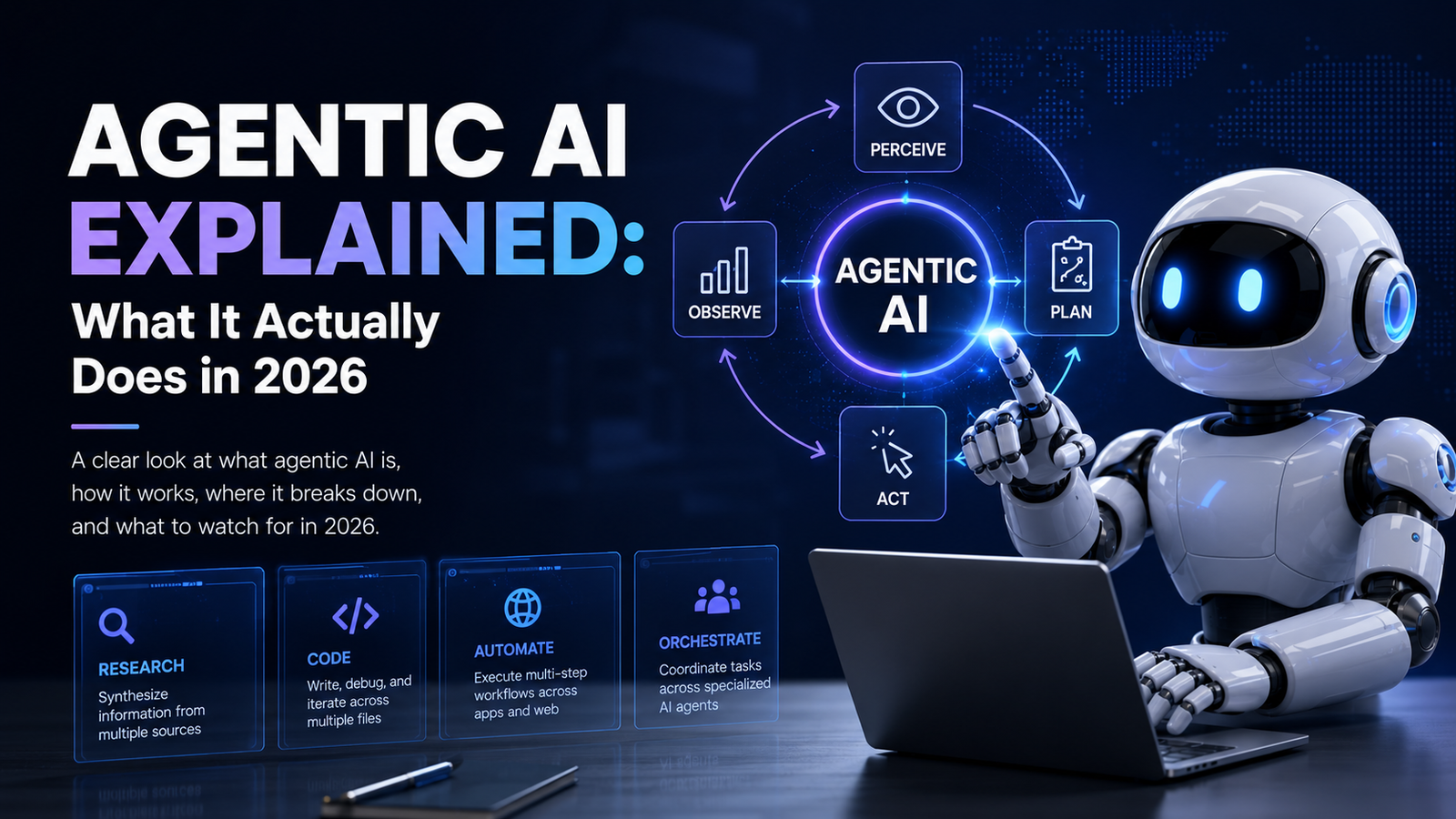
Strip away the marketing and every AI agent runs some version of the same loop: Perceive → Plan → Act → Observe → Repeat.
- Perceive: The agent takes in its current context — your instructions, tool outputs, memory, environmental state.
- Plan: It decides what to do next, usually by prompting a model to reason through the problem.
- Act: It executes — calling an API, writing code, clicking a button, sending a request.
- Observe: It reads the result of that action.
- Repeat: It loops back and decides what comes next, updating its plan based on what it learned.
The physical components making this work: the model (the reasoning brain — GPT-4o, Claude 3.5, Gemini 1.5), the tools (APIs, web browsers, code interpreters, file systems), memory (short-term context window plus, increasingly, long-term vector retrieval), and the task instructions that tell the agent what it’s actually trying to accomplish.
You’ve already encountered real versions of this. Devin handles multi-file coding tasks autonomously. OpenAI Operator browses the web and completes tasks on your behalf. Claude’s computer use feature lets it control a desktop environment. AutoGPT’s successor projects are running production workflows. Microsoft 365 Copilot Agents execute multi-step tasks across Teams, Outlook, and SharePoint without you switching tabs.
InsiderXP Fact: As of 2026, major agentic AI deployments like OpenAI Operator, Microsoft 365 Copilot Agents, and Anthropic’s Claude computer use — all run variants of the same Perceive → Plan → Act → Observe loop, regardless of their commercial branding.
Autonomous AI in Practice — What It Can Actually Do Today
As of 2026, autonomous AI handles certain categories of work reliably well:
- Research synthesis: Pulling from multiple sources, summarizing, structuring findings
- Code generation and debugging pipelines: Writing, running, catching errors, iterating
- Browser-based task automation: Form filling, data extraction, multi-site workflows
- Customer service escalation handling: Resolving defined issue types, routing edge cases
- Multi-app workflow execution: Moving data between tools, triggering downstream actions
The honest capability ceiling: agents handle well-defined, bounded tasks reliably. Give an agent a clear goal, a constrained environment, and good tooling, and it performs. Give it an open-ended objective with ambiguous success criteria and a messy real-world environment, and it will drift, confuse itself, or confidently do the wrong thing.
Here’s the mental model worth keeping: genuinely impressive means agents completing coding tasks, automating 10-step research workflows, or managing customer service queues with minimal oversight. Still a demo means agents that “autonomously run your business,” adapt fluidly to completely novel situations, or reliably handle tasks requiring deep contextual judgment over long time horizons.
The gap between those two categories is where most of the current hype lives.
[AI agent running store in San Francisco]
AI Orchestration — How Multi-Agent Systems Coordinate
Single agents hit limits fast. Complex tasks need specialization. That’s where AI orchestration comes in.
Orchestration means using a manager agent to delegate sub-tasks to specialized worker agents. The orchestrator holds the overall goal and decides which agent handles which piece. A worker agent focused on web research doesn’t need to know how to write code. A coding agent doesn’t need to browse the web. The orchestrator coordinates across both.
Frameworks you’ll encounter in the wild: LangGraph for stateful agent workflows, AutoGen from Microsoft for multi-agent conversation patterns, CrewAI for role-based agent teams, OpenAI’s Swarm (still experimental), and AWS Bedrock Agents for enterprise deployments.
Orchestration is genuinely powerful for enterprises. It’s also where complexity compounds fast. Here’s the reliability math: if a single agent completes a task correctly 90% of the time, a three-agent pipeline where each depends on the last runs correctly around 73% of the time, assuming independent failure rates. Errors cascade. A hallucinated output from a research agent becomes the flawed premise that a planning agent acts on.
InsiderXP Fact: In a three-agent pipeline where each agent operates at 90% reliability, the compounded success rate drops to roughly 73% — meaning roughly 1 in 4 end-to-end tasks will contain an error introduced somewhere in the chain.
Multi-agent systems need tighter guardrails, not looser ones — despite how many demos show them running unsupervised.
Where Agentic AI Breaks Down — The Failure Modes Nobody Advertises
This is the section vendor explainers skip. Let’s be specific.
Hallucinated actions. Agents don’t just hallucinate facts — they hallucinate steps. They’ll delete the wrong file, send an email before it’s ready, or call an API with fabricated parameters. Confident and wrong is a bad combination when actions have real-world consequences.
Context drift. Long multi-step tasks cause agents to lose the thread. By step 15, the agent may be technically executing sub-goals that have drifted meaningfully from the original objective. The model’s attention is finite. Instructions set 10 steps ago get diluted.
Tool misuse. Agents call APIs incorrectly, chain calls in unintended sequences, or interpret tool documentation in ways that produce cascading errors. The more tools an agent has access to, the larger the surface area for this.
Infinite loops and stuck states. Agents can spin indefinitely when they hit an unexpected state, retrying failed approaches without detecting that they’re not making progress. Without explicit loop-detection, they’ll keep trying.
Prompt injection. This one doesn’t get enough attention. Agents that browse the web or read external documents are vulnerable to adversarial content designed to hijack their instructions. A malicious webpage can instruct your agent to exfiltrate data or change its behavior. This is an active attack vector, not a theoretical one — and it has been formally documented by OWASP’s LLM security researchers.
The honest answer to most reliability questions is still human in the loop — at least for high-stakes actions. “Fully autonomous” is a pitch. Supervised autonomy with well-placed checkpoints is what actually works in production right now.
[INTERNAL LINK: AI safety and enterprise deployment best practices]
Why Agentic AI Actually Matters for You in 2026 — Not in Theory
The shift agentic AI creates isn’t about AI getting smarter in the abstract. It’s about removing the steps between you and a completed task.
For developers: GitHub Copilot Workspace and Cursor’s agent mode aren’t just autocomplete — they’re running test suites, catching their own errors, and iterating across entire features. The bottleneck is less often “writing code” and more often “knowing what to ask for.”
For knowledge workers: Microsoft 365 Copilot Agents and Notion AI are handling the retrieval, synthesis, and first-draft tasks that used to eat hours. The value is real when the task is repeatable and the inputs are clean.
For ops teams: Zapier’s AI agents and Make’s AI-enabled automation steps are collapsing multi-tool workflows that previously required human handoffs between systems.
Honest ROI read: where inputs are structured, tasks are repeatable, and failure is recoverable, agents save real time today. Where tasks require judgment, involve sensitive systems, or have low tolerance for error, implementation overhead and reliability gaps still frequently outweigh the benefit. The business case exists — it just requires being precise about which category your use case falls into.
Agentic AI isn’t the future of work arriving all at once. It’s a specific, powerful capability that works well in specific, well-scoped conditions. Know the conditions. Deploy accordingly.
Frequently Asked Questions About Agentic AI
1. What is the difference between agentic AI and a regular chatbot?
A regular chatbot takes a single input and returns a single output — the interaction ends there. Agentic AI, by contrast, takes a goal and pursues it across multiple steps: it plans, executes actions using external tools, evaluates results, and loops until the task is complete. The core distinction is that a chatbot responds while an agentic system acts. A chatbot tells you how to book a flight; an agentic AI books it for you.
2. Can agentic AI work without human supervision?
In bounded, well-defined tasks with recoverable failure modes — yes, agentic AI can operate with minimal human oversight today. In high-stakes, complex, or ambiguous workflows, full autonomy remains unreliable. Current best practice in production deployments is supervised autonomy: the agent runs independently but humans review or approve critical actions. “Fully autonomous” is largely still a marketing claim rather than a production reality for anything consequential.
3. What are the most common agentic AI tools available in 2026?
The most widely deployed agentic AI tools in 2026 include OpenAI Operator (browser-based task execution), Microsoft 365 Copilot Agents (enterprise workflow automation across Teams, Outlook, and SharePoint), Anthropic Claude with computer use (desktop environment control), GitHub Copilot Workspace and Cursor (agentic coding), and Devin by Cognition AI (autonomous software engineering). On the infrastructure side, LangGraph, AutoGen, and CrewAI are the dominant frameworks for building custom multi-agent systems.
4. What is AI orchestration and why does it matter?
AI orchestration is the coordination of multiple specialized AI agents by a managing “orchestrator” agent that holds the overall goal and delegates sub-tasks. It matters because individual agents have capability limits — a research agent and a coding agent can each do their job well, but they need coordination to work together on a complex task. Orchestration enables more sophisticated workflows, but it also compounds reliability risk: errors from one agent propagate to the next, which means a three-agent pipeline at 90% individual reliability runs correctly only ~73% of the time.
5. Is agentic AI safe to use in business workflows?
Agentic AI carries specific risks that traditional software does not, including hallucinated actions (executing incorrect steps with confidence), context drift over long task sequences, and prompt injection attacks — where malicious content in documents or websites hijacks the agent’s instructions. For business use, safety depends heavily on scope: agents work well for structured, low-stakes, reversible tasks. For sensitive systems or irreversible actions, robust guardrails, permission scoping, and human checkpoints are essential. OWASP has formally documented LLM-specific vulnerabilities including prompt injection as active security concerns.
6. How is agentic AI different from traditional automation or RPA?
Traditional automation and Robotic Process Automation (RPA) follow rigid, pre-programmed rules — they execute exactly the steps they were programmed for and fail when encountering anything outside that script. Agentic AI can reason about novel situations, adapt its approach mid-task, use natural language instructions instead of hard-coded rules, and work across unstructured data. The trade-off is that agentic systems are less predictable than RPA: they’re more flexible but introduce failure modes like hallucination and context drift that rule-based automation simply doesn’t have.
By the InsiderXP Editorial Team | UT Senpai