
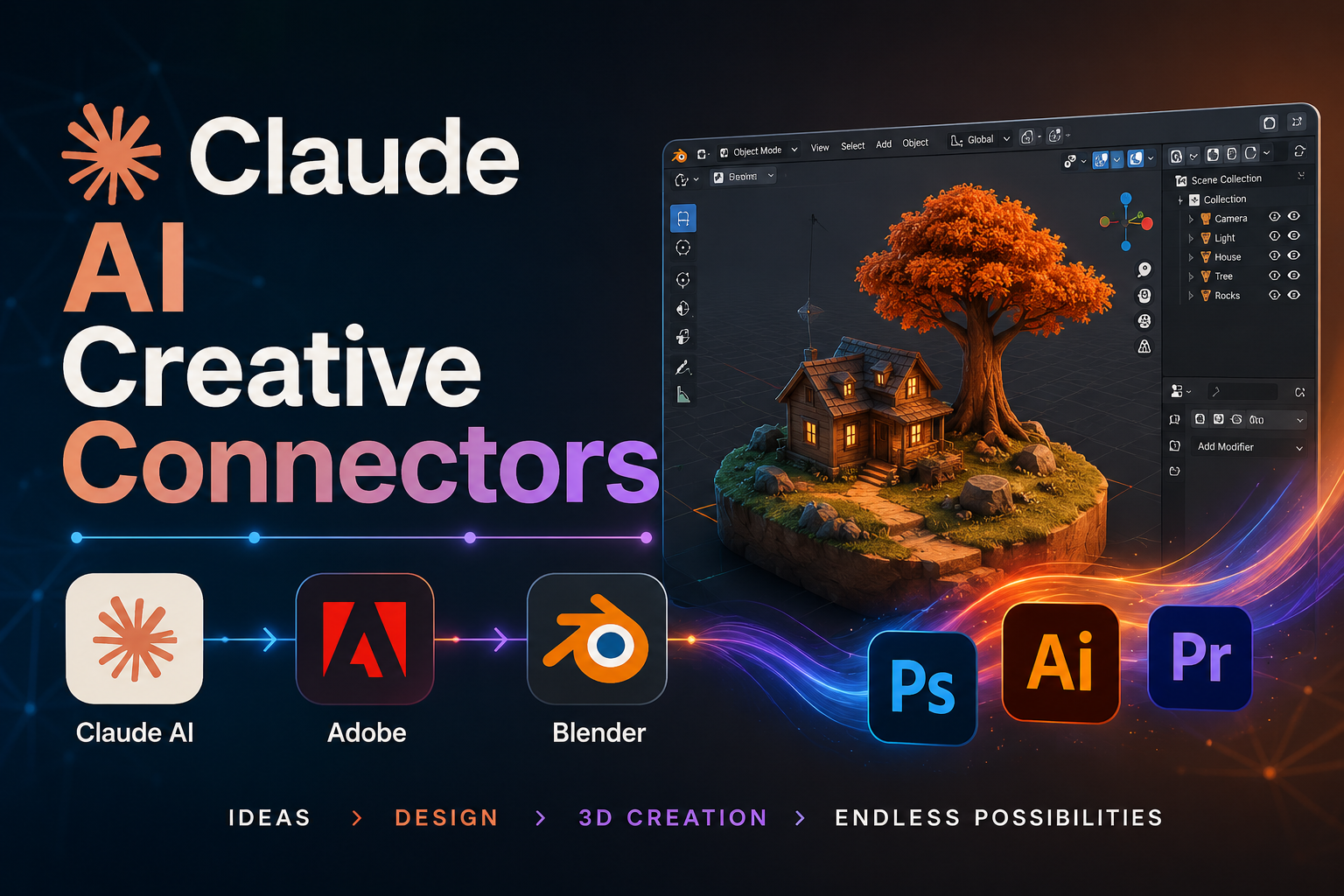
Anthropic didn’t just add integrations. It made a structural argument about where AI belongs in the creative stack. Nine new connectors. Adobe and Blender as the marquee names. And underneath all of it, a 200K-token context window that none of Claude’s competitors can match. The Claude creative connectors Adobe Blender announcement isn’t Anthropic playing catch-up with generative image tools. This is a deliberate bid to own the workflow layer of creative AI — the connective tissue between briefs, assets, feedback, and final output. That’s a different game entirely. And most coverage is missing it.
What Are the 9 Claude Creative Connectors & Why Now?
The full line-up of Anthropic connectors includes Adobe, Blender, Cloudflare, Intercom, Linear, Sentry, Web flow, Asana, and Jira (Source: Anthropic News). Creative professionals will clock Adobe and Blender immediately. The rest skew toward developer and project management workflows — which tells you something about how Anthropic sees the overlap between creative work and operational infrastructure.
The timing is deliberate. Adobe Firefly has matured into a credible generative media platform. Midjourney, Runway, and a dozen others have carved out loyal niches. The first wave of creative AI is settled enough that a serious challenger needs to come in at a different altitude.
Connectors aren’t API integrations with a marketing gloss. They’re purpose-built workflow bridges that allow Claude to read context from, write outputs to, and maintain continuity across external tools. The distinction matters. An API bolt-on lets you trigger a function. A connector lets Claude understand what’s happening inside a tool and respond with that awareness intact.
That’s the bet Anthropic is making. Not “Claude can generate images too.” But “Claude can understand your entire creative project and operate intelligently across every tool you use.”
Claude for Creative Work Is a Different Proposition Than You Think
- Most AI tools competing for creative professionals are generation-first. Firefly generates images and vectors. X generates images. Runway generates video. The intelligence is in the output.
- Claude’s intelligence is in the context surrounding the output. That’s a fundamentally different value proposition for Claude creative tools — and it reframes the entire competitive conversation.
- Creative work is 20% making things and 80% everything else — briefs, revisions, client feedback, style decisions, asset management, creative direction conversations. Claude’s language understanding means it can operate in all of that ambient complexity. It can read a creative brief and understand tone. It can process a feedback thread and identify the actual ask buried in the noise. It can hold a style guide and apply its constraints without being re-prompted every session.
- Calling Claude an “assistant” in this context undersells what it actually does. Assistants help. Claude can hold the entire conceptual framework of a project and act as an intelligent layer across its full lifecycle.
- That changes what “integration” means. It’s not about Claude helping you do a task. It’s about Claude understanding the project the task belongs to.
InsiderXP Fact: Claude for creative work operates at the workflow layer — not the asset generation layer. Its 200,000-token context window means it can simultaneously hold a creative brief, style guide, revision history, and client feedback archive without truncation, a capability no competing creative AI tool currently matches.
The Extended Context Window Is the Structural Advantage Nobody Is Talking About
- Here’s the stat that rewrites the competitive landscape: Claude’s context window sits at 200,000 tokens — roughly 150,000 words (Source: Anthropic — Claude model specifications). That’s enough to hold a complete creative brief, a full style guide, months of revision notes, an asset manifest, and a client feedback archive simultaneously. No other creative AI tool operates at that scale. Not Firefly. Not Runway. Not anything in the current Adobe ecosystem.
- The practical scenario: a design team working on a brand campaign loads their brief, their approved mood board descriptions, three rounds of client feedback, and their internal style guidelines into Claude at the start of the engagement. Claude holds all of it. Every output, every suggestion, every revision note is produced with that complete context active — not a summarized version, not a truncated window, the whole thing.
- This is what makes the connector strategy structurally coherent rather than just a feature announcement. Anthropic connectors pull live context from Adobe, from Blender, from project management tools. The 200K window means Claude can actually hold all of that simultaneously without losing fidelity. That’s not a spec sheet win. That’s a moat.
- Multi-session creative projects — the kind that run for weeks or months — are where AI tools typically break down. Context resets. You re-explain. The tool forgets. Claude’s architecture is built to solve exactly that problem. And it’s doing it at scale that competitors haven’t matched.
Adobe and Blender Are the Anchors — But the Full List Signals a Strategy
- The Adobe connector is the headline, and it deserves scrutiny. Based on Anthropic’s announcement, it operates across the Creative Cloud ecosystem, touching Firefly’s API layer and metadata structures. What it doesn’t do — yet — is generate media directly inside Photoshop or Illustrator. The integration is primarily about intelligent context and workflow orchestration, not pixel pushing.
- That framing is important. Claude isn’t trying to replace Firefly inside Adobe’s tools. It’s positioning itself above Firefly — as the intelligence layer that understands what you’re making and why, while Firefly handles the generative media execution.
- The Blender integration is arguably more technically interesting. Claude can provide scripting assistance, interpret and generate scene descriptions, and support procedural generation workflows. Blender’s Python scripting API is well-documented and widely used across the 3D community, but it carries a steep learning curve for non-developers. Having Claude work as an intelligent co-pilot in that environment compresses that curve significantly.
- The remaining seven connectors — Cloudflare, Intercom, Linear, Sentry, Webflow, Asana, Jira — read as deliberate pipeline completeness. Webflow pulls in web design. Asana and Jira cover project coordination. The pattern isn’t random. Anthropic is mapping the full surface area of where creative and product work intersects with operational tooling.
The gaps are notable. No Figma. No DaVinci Resolve. No Spotify or audio production tooling. Whether those are next or not on the roadmap, their absence in this round is the question mark creative professionals should be tracking.
Is This a Direct Threat to Adobe Firefly?

Yes. But not in the way Adobe’s product team is probably modeling it.
Firefly is generative media: images, vectors, video, effects. Claude is generative intelligence around media. The overlap isn’t direct competition at the asset generation level — it’s competition at the value layer.
Here’s where Adobe should be paying close attention: the connector model means Claude doesn’t need to replace Firefly to undercut its value proposition. If Claude becomes the primary interface through which creative teams manage, direct, and iterate on projects — and Firefly is just one of the generative engines Claude orchestrates — then Adobe’s customer relationship has shifted. The intelligence layer moves to Anthropic. Adobe becomes infrastructure.
That’s not a hypothetical. That’s the exact dynamic the connector strategy enables if it achieves adoption.
InsiderXP Fact: Adobe Creative Cloud serves over 30 million subscribers worldwide, giving it significant enterprise lock-in. But subscriber scale doesn’t protect against a scenario where a third-party intelligence layer — like Claude — becomes the primary interface through which teams direct their creative work before they ever open Photoshop.
Claude Design and the Bigger Picture for Creative Professionals
- Anthropic has signaled Claude Design as a product direction — a dedicated creative mode or vertical within the Claude ecosystem. The specifics remain thin, but the signal is clear: Anthropic is treating creative professionals as a first-class audience, not a use case to bolt onto a general-purpose AI.
- For freelancers and small studios, the connector ecosystem is genuinely interesting if the integrations hold up under real-world workflow conditions. The ability to bring Claude into Blender and Adobe without switching contexts could meaningfully compress the friction in production pipelines.
- For agencies and in-house creative teams, the enterprise calculus is more complex. Adding Claude connectors to an existing stack raises a real question: does this simplify the AI layer, or does it add another system to manage, maintain, and explain to clients?
The honest answer in 2026 is: probably both, initially. The tools that win will be the ones that reduce cognitive overhead fast enough to justify the onboarding cost.
What Anthropic Gets Right — and Where the Risks Are
The connector strategy is coherent. The context window advantage is real and documented. Anthropic is attacking a genuine gap in the creative AI market — not building a Firefly clone.
But two risks are worth naming clearly.
Risk one: adoption friction. Creative professionals are notoriously tool-loyal. Integrations need to be invisible to stick. If the Adobe connector requires constant re-authentication, drops context at inconvenient moments, or adds steps to existing workflows, it won’t survive contact with deadline-driven creative teams regardless of how technically impressive it is.
Risk two: Adobe’s defensive capability. If Adobe accelerates Firefly’s contextual intelligence features — or tightens API access to make third-party orchestration harder — Claude’s structural window narrows. Adobe has the resources to respond, and it has every incentive to do so. Adobe’s market capitalisation sits above $150 billion, giving it significant runway to invest in competitive countermeasures.
Neither risk is fatal. Both are real.
Frequently Asked Questions
1. What are the 9 Claude AI creative connectors announced by Anthropic?
Anthropic announced nine connectors as part of its Claude integration push: Adobe, Blender, Cloudflare, Intercom, Linear, Sentry, Webflow, Asana, and Jira. Adobe and Blender are the headline names for creative professionals, while the rest address developer tooling and project management workflows. The mix signals that Anthropic sees creative work and operational infrastructure as deeply overlapping, not separate domains.
2. How does the Claude Adobe connector work inside Creative Cloud?
The Claude Adobe connector operates across the Creative Cloud ecosystem, interfacing with Firefly’s API layer and Adobe’s metadata structures. It functions primarily as an intelligent context and workflow orchestration layer rather than a direct media generation tool — Claude won’t generate pixels inside Photoshop, but it can understand your project, interpret briefs and feedback, and direct workflows across Adobe’s toolset. Think of it as the intelligence sitting above Firefly, not competing with it at the asset level.
3. What does the Claude Blender integration actually let you do?
The Claude Blender integration enables scripting assistance, scene description interpretation, and support for procedural generation workflows inside Blender’s 3D environment. Blender’s Python scripting API is powerful but has a steep learning curve for non-developers; Claude acts as an intelligent co-pilot that can generate, explain, and troubleshoot scripts in context. This makes advanced Blender functionality meaningfully more accessible to artists who aren’t coders.
4. Is Claude Design a separate product or a feature within Claude?
Claude Design is a product direction Anthropic has signalled — a dedicated creative mode or vertical within the Claude ecosystem — but full specifics have not been released as of this article. It indicates Anthropic intends to treat creative professionals as a distinct, first-class audience rather than a general use case. Whether it launches as a standalone product, a Claude tier, or a bundled feature set remains to be confirmed by Anthropic.
The connectors are live. The context window advantage is structural. The question isn’t whether Anthropic has made a serious move into creative workflows — it clearly has.
The question is whether your studio’s AI stack is still organized around tools that generate assets, or whether it’s ready for a layer that understands the whole project. Those are different bets. And the gap between them is widening fast.
By the InsiderXP Editorial Team | May 07, 2026