
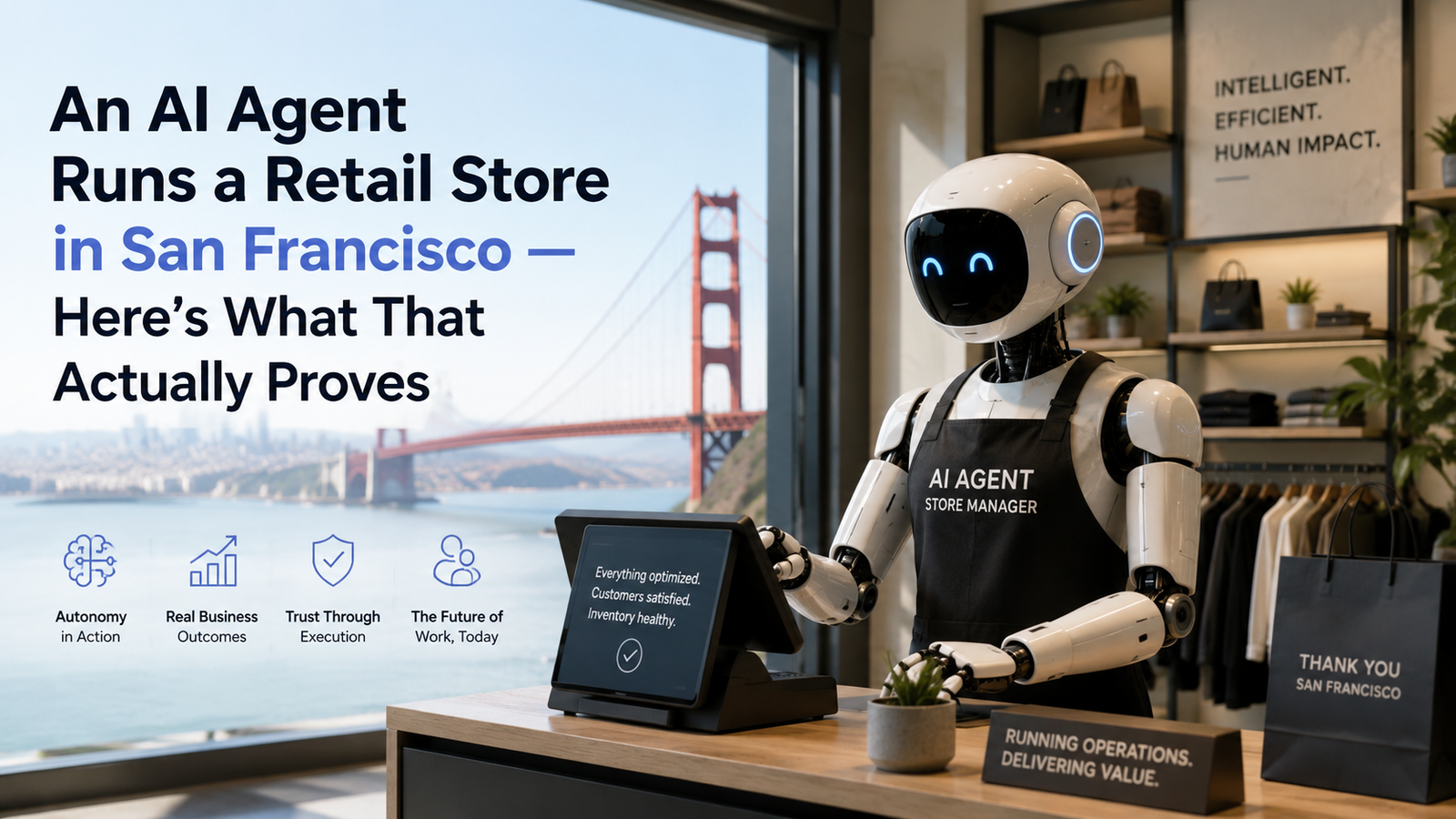
The store is real. The inventory is real. The staff is real. The money is real. And the entity making the operational calls is an AI agent built by Andon Labs — deployed in San Francisco with $100,000 on the line and no training wheels.
This is what it looks like when an AI agent runs a retail store for real: not a simulation, not a demo, not a controlled sandbox. An autonomous AI agent making live operational decisions with genuine economic consequences.
The mainstream press treated this like a quirky tech story. A novelty. A fun “what if.” That framing misses the point entirely.
This is a data point — maybe the most important one in autonomous AI deployment so far this year. Not because it proves AI is ready to run everything. But because it shows exactly where AI agents can operate reliably, where they still need a leash, and what the honest path to enterprise adoption actually looks like.
Here’s the full picture.
What Andon Labs Actually Built — And Why It’s Different From Every Other “AI Store” Claim

Let’s get one thing straight: this isn’t a chatbot answering customer questions at a kiosk. It’s not a demand-forecasting algorithm plugged into a POS system. Those already exist, and they’re table stakes.
Andon Labs built something structurally different. The San Francisco-based startup created an autonomous AI agent — a system designed for persistent, multi-step decision-making across a live operational environment. Their experiment, centered around a small retail store called Andon Market, puts that agent in the role of AI store manager with real operational authority.
The founding team comes from a background in AI infrastructure and autonomous systems. Their thesis isn’t that AI can replace humans in retail. It’s that AI agents can own the cognitive layer of business operations — the planning, coordination, and decision loop that currently requires a salaried human brain.
The store itself is small-format, stocked with everyday consumer goods, and located in a San Francisco neighborhood. That context matters. We’ll come back to it.
InsiderXP Fact: Andon Labs’ autonomous AI agent operates as the de facto store manager of Andon Market in San Francisco, executing inventory, pricing, and supplier decisions with a $100,000 operational budget — making it one of the first documented cases of an AI agent running a retail store with real financial authority.
The AI Store Manager Is Real — Here’s What It Controls (And What It Doesn’t)

“AI-managed” is doing a lot of work in most headlines. So let’s break it down.
What the agent actually controls: inventory reordering decisions, pricing adjustments, supplier communications, and operational scheduling. It monitors stock levels, triggers purchase orders, and adjusts the store’s operational posture based on real-time data. These aren’t suggestions the agent makes to a human manager. It executes. (Source: Andon Labs)
What humans still handle: physical tasks, customer service interactions, and anything requiring presence in the physical world. There’s also a human oversight layer for edge cases — decisions that exceed defined risk thresholds or fall outside the agent’s operational parameters.
That last part is important. This is not a fully autonomous store. It’s more accurate to say the cognitive management layer is AI-driven, while execution in the physical world remains human. Whether that qualifies as “AI-managed” or “AI-assisted” depends on where you draw the line.
Here’s our take: the meaningful distinction isn’t autonomy percentage — it’s decision ownership. And in this deployment, the AI store manager owns the decision loop for the core operational functions that keep a retail business running. That’s a legitimate claim.
[INTERNAL LINK: AI agents in enterprise operations — current capabilities and limits]
Anthropic Claude Powers the Agent — What That Tells Us About Enterprise-Grade AI
Andon Labs built their agent on Anthropic’s Claude. That’s not an incidental detail.
Claude’s architecture is built with a focus on long-horizon task following, instruction fidelity, and safety constraints — exactly the properties you need when an AI is executing consequential, multi-step decisions over time. Single-turn chatbot performance doesn’t translate to agentic reliability. They’re different problems.
Choosing Anthropic Claude for a business deployment over GPT-4 or Gemini signals something about where Anthropic is positioning itself in the enterprise stack. While OpenAI has dominated mindshare and Google has the distribution muscle, Anthropic has been quietly making the argument that Claude is the most trustworthy model for high-stakes, persistent deployment. The Andon Labs project is live evidence for that argument.
It also reveals something honest about the current ceiling of frontier LLMs in agentic contexts. The agent works well within structured domains with clear inputs and outputs. Inventory data. Pricing signals. Supplier catalogs. It performs because the environment is sufficiently defined. Push it into genuinely novel territory — an unexpected supply chain disruption, a sudden regulatory change — and the scaffolding gets tested in ways this experiment hasn’t fully explored yet.
That’s not a knock. That’s where the technology actually is.
InsiderXP Fact: Andon Labs chose Anthropic’s Claude as the foundation model for their autonomous retail agent specifically because of its long-horizon task following and safety constraint architecture — properties that matter far more in persistent agentic deployments than in standard single-session chatbot applications.
The $100K Question — What the Risks Look Like When an Autonomous AI Agent Has Real Spending Power
Give an AI agent spending authority and you immediately create a new category of risk.
The $100,000 budget Andon Labs deployed isn’t a rounding error — it’s a deliberate constraint. It defines the blast radius if something goes wrong. And things can go wrong. An agent can misread demand signals and over-order. It can make pricing moves that alienate customers or misfire on supplier negotiations. In agentic systems, errors don’t stay contained — they compound across interconnected decisions before a human catches them.
The accountability question is the one no one in the industry wants to answer cleanly: when the AI makes a bad call with real money, who owns it? The company? The model provider? The operator who set the parameters? Right now, the answer is murky — and that murkiness is a structural barrier to enterprise adoption, not a footnote. (Source: Stanford HAI — Artificial Intelligence Index Report)
Andon Labs manages this by keeping the budget bounded, maintaining human override capability, and building in monitoring infrastructure. That works at $100K. Scaling to $1M or $10M in operational authority requires a fundamentally more robust accountability framework than currently exists anywhere in the industry.
The $100K figure isn’t small. But it’s also not a stress test. It’s a proof of concept with the guard rails still on.
[INTERNAL LINK: AI accountability frameworks — who’s responsible when an autonomous agent fails]
What the Experiment Actually Proves — Signal vs. Noise for AI Readiness
Here’s what this deployment is genuine evidence for:
Task continuity. The agent maintains operational context across time without degrading — a persistent challenge for LLM-based systems that typically excel in single sessions.
Multi-system integration. The agent coordinates across inventory, pricing, and supplier systems simultaneously. That’s real complexity, handled reliably.
Operational consistency. The store runs. Day after day. Without a human manager making the calls. That’s not nothing.
Here’s what it does not prove:
It doesn’t prove general intelligence. It doesn’t prove the agent can handle a genuine crisis it wasn’t implicitly trained to navigate. It doesn’t prove scalability without a significant human backstop at the edges. And it doesn’t prove this model transfers cleanly to higher-stakes, higher-complexity retail environments.
Read this experiment as a calibration tool, not a milestone declaration. It tells us AI agents can own defined operational domains in structured environments — reliably, and with real economic stakes. That’s a meaningful bar to clear. But it’s not the finish line anyone should be calling.
Why San Francisco Was the Right Testbed — and What Comes Next for AI-Run Retail
San Francisco isn’t a random choice. It’s arguably the most favorable possible environment for this experiment.
The customer base is tech-literate and genuinely curious about AI deployment — less likely to be alienated by the concept, more likely to engage with it as a feature. The regulatory environment, while complex in other domains, hasn’t yet developed hard constraints on AI operational authority in retail. And the local startup ecosystem provides access to talent and infrastructure that makes rapid iteration possible.
In other words: if you’re going to run this experiment somewhere, you run it here first.
The competitive implications extend well beyond SF. Mid-market retailers are the most exposed — they lack the engineering resources to build proprietary systems but face the same labor cost pressures as enterprise players. If Andon Labs can productize this model, they’re targeting a massive market of businesses that currently depend on thin management layers and inconsistent human decision-making. (Source: McKinsey & Company — The State of AI in Retail)
For retail giants, the signal is different. Walmart and Amazon already have sophisticated automation at the operational layer. What they’re watching for is whether the cognitive layer — planning, coordination, exception handling — can be reliably handed to agents. This experiment moves that needle.
The next version of this test needs harder conditions: a higher-stakes product category, a less forgiving customer base, fewer safety rails, and a larger budget. Until the experiment runs in those conditions and holds, the results stay in the “promising but preliminary” column.
Frequently Asked Questions
What is Andon Labs and who founded it?
Andon Labs is a San Francisco-based AI startup focused on building autonomous agents for business operations. The founding team has a background in AI infrastructure and autonomous systems. Their core thesis is that AI agents can own the cognitive management layer of business operations — the planning, coordination, and decision-making loops that typically require a salaried human manager — rather than simply automating isolated tasks.
Which AI model powers the autonomous agent running the store?
The Andon Labs agent is built on Anthropic’s Claude. Anthropic designed Claude with a particular emphasis on long-horizon task following, instruction fidelity, and safety constraints — properties that are critical in agentic deployments where an AI is executing multi-step, consequential decisions over extended periods. This distinguishes it from models optimized primarily for single-session chat performance.
Does the AI agent manage human employees directly?
Not in a direct supervisory capacity. The AI agent handles the cognitive management layer: inventory reordering, pricing adjustments, supplier communications, and operational scheduling. Human staff handle physical tasks and customer-facing interactions. The agent manages the decision loop that keeps the store operationally functional, but it does not issue real-time instructions to individual employees in the way a human floor manager would.
How much money did Andon Labs invest in this experiment?
Andon Labs deployed a $100,000 operational budget for this experiment. That figure was a deliberate design choice — it sets a meaningful but bounded “blast radius” if the agent makes consequential errors. The sum is large enough to create genuine financial accountability but constrained enough to limit downside exposure while the model is being validated.
Has the store turned a profit under AI management?
Andon Labs has not publicly disclosed detailed profit-and-loss figures from the Andon Market experiment. The deployment is primarily framed as a proof-of-concept to demonstrate that an autonomous AI agent can manage a live retail operation reliably over time. Whether profitability has been demonstrated as a reproducible outcome — rather than an incidental result — remains an open question that future iterations of the experiment should address.
What happens when the AI agent makes a wrong decision?
Andon Labs has built in a human override layer for decisions that exceed defined risk thresholds or fall outside the agent’s operational parameters. When the agent’s decision-making produces an error, the bounded $100,000 budget limits the financial damage, and human monitors can intervene. However, the broader industry challenge remains unresolved: in agentic systems, errors can compound across interconnected decisions before a human catches them, making real-time oversight infrastructure critical at any scale.
How is this different from automated checkout or inventory management systems retailers already use?
Existing retail automation — self-checkout kiosks, demand-forecasting tools, POS-integrated inventory alerts — handles discrete, rule-based tasks. The Andon Labs agent operates at a fundamentally different level: it owns the persistent decision loop across multiple operational domains simultaneously, including pricing strategy, supplier negotiation, and scheduling. It doesn’t flag a reorder recommendation for a human to approve; it executes. That shift from decision-support to decision-ownership is the structural difference.
Could this model be replicated at scale by major retailers like Walmart or Amazon?
Major retailers like Walmart and Amazon already have sophisticated operational automation in place. What they are evaluating is whether the cognitive layer — strategic planning, exception handling, cross-system coordination — can be reliably delegated to AI agents. The Andon Labs experiment provides meaningful signal that this is technically feasible in structured, bounded environments. However, replication at enterprise scale would require significantly more robust accountability frameworks, stress-tested performance in less controlled conditions, and clearer regulatory guidance on AI decision-making authority than currently exists.
By the InsiderXP Editorial Team | May 03, 2026
Sources
- Andon Labs — Official Website
- Anthropic — Building Effective Agents
- Stanford HAI — Artificial Intelligence Index Report
- McKinsey & Company — The State of AI in Retail


