
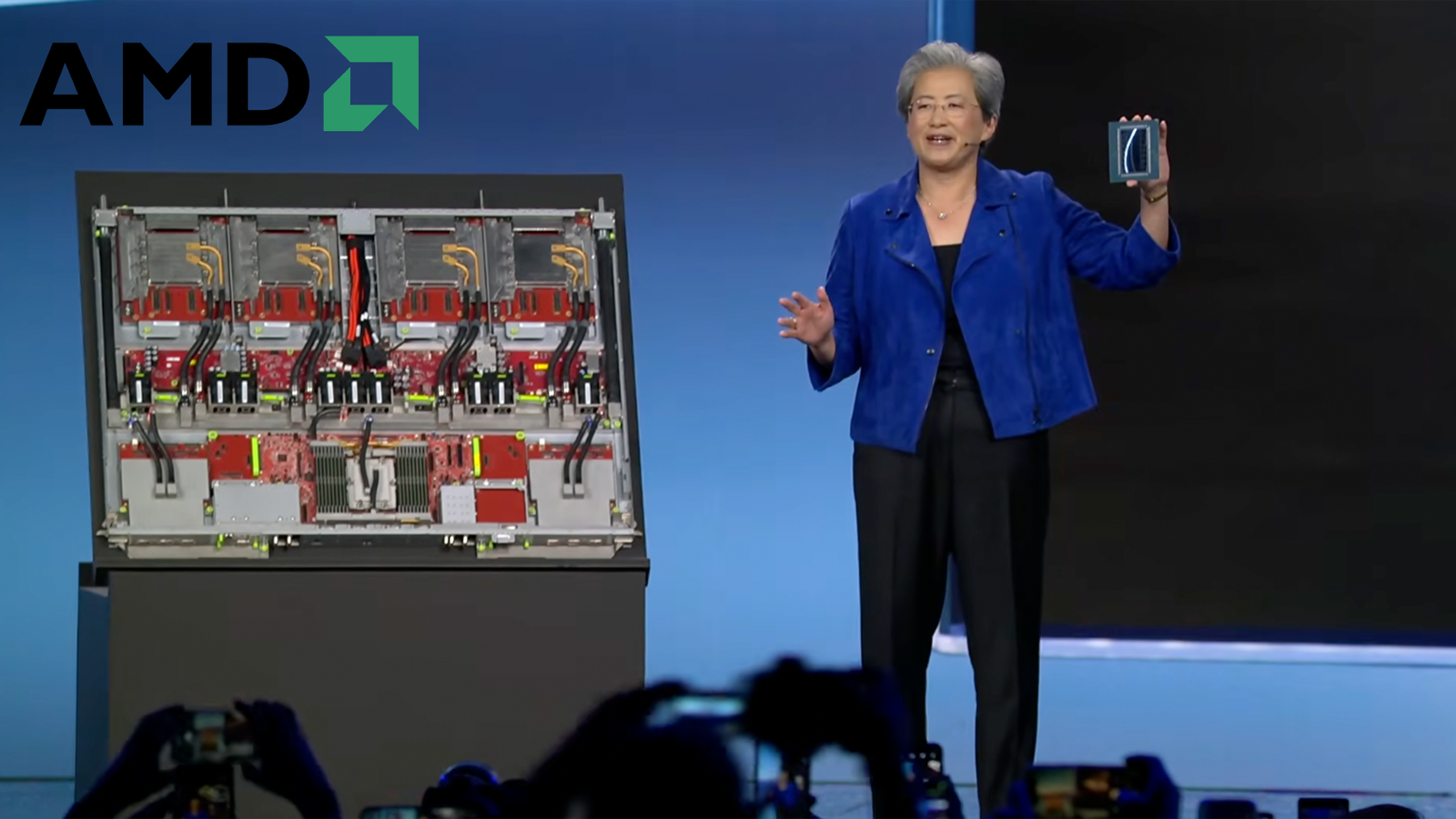
AMD noted that CES 2026 will showcase its latest generational offerings for processors, its graphics technology, and its software platforms. AI will be a large part of AMD’s product portfolio moving forward. The announcements in January 2026 indicate AMD’s intention of bringing the computing power of AI from the cloud to personal computing and gaming systems and eventually, the edge.
Gaming Processors and Graphics Push Performance Boundaries
Highlights from CES 2026

AMD has announced the new Ryzen 7 9850X3D as the fastest CPU for gaming on the market. This is the next model in the Ryzen 9000X3D family, and it combines the second generation of 3D V-Cache technology with Zen 5 architecture. With eight cores, 16 threads, a maximum boost clock speed of 5.6 GHz, and a total of 104 MB of cache, the Ryzen 7 9850X3D was designed to provide extremely low latency and high frame rates for the most demanding games. Systems with the Ryzen 7 9850X3D are expected to be available from OEMs and retailers by Q1 2026.
In addition to the new Ryzen 7 9850X3D, AMD has highlighted how widely implemented its FidelityFX Super Resolution, or “FSR” Redstone Suite—an AI-based rendering technology that enables over 200 games—is. The Redstone Suite utilizes machine-learning-based upscaling, frame creation, and neural rendering to enhance graphics with minimal reduction in performance. Other new tools, FSR Radiance Caching and FSR Ray Regeneration, accelerate the ray tracing process through machine-learning techniques and produce more realistic reflections and lighting.
AI PCs Drive Local Intelligence
They were highlighting AI at the center of their announcements about consumer and enterprise processors with the introduction of the Ryzen AI 400 Series. These CPUs are built on the Zen 5 architecture and designed specifically for the new generation of Copilot+-powered PC devices. With the next generation of NPUs, the enhanced version of their XDNA 2 NPU, these processors will enable up to 60 TOPS of AI compute capabilities.
AMD’s flagship offering in this series is the Ryzen AI 9 HX 475, which consists of 12 cores, 24 threads, and integrated Radeon 800M graphics. Targeting generative AI and on-device voice assistant applications, the Ryzen AI 9 HX 475 is expected to be available in laptops in Q1/Q2 of 2026, with desktop versions to follow in the second quarter of 2026.
For thin-and-light designs, they have introduced the Ryzen AI Max+ line of products, which includes the 12-core 392 and 8-core 388 SKUs. These products feature a combination of Zen 5 CPUs, Radeon 8060S GPUs, and a second-generation NPU that provides up to 50 TOPS of system-level AI compute capabilities, making them well suited for ultrathin notebooks and compact mini PCs.
AMD has also introduced the Ryzen AI Halo development platform. The Ryzen AI Halo is a compact system that supports up to 128 GB of unified memory and can achieve 60 TFLOPS of RDNA 3.5 graphics performance. The system comes equipped with the ROCm 7.2 software development kit, along with hundreds of pre-trained models, to help developers rapidly experiment with the use of large local models for use in edge-based AI applications.
On the enterprise side, AMD launched the Ryzen AI PRO 400 Series, extending AI capabilities to business laptops and desktops. With PRO security, manageability, and platform stability, the top-tier HX PRO 475 matches the consumer flagship’s 12 cores and 60 TOPS AI performance for professional environments.
Data Centre, Software, and Embedded Platforms Extend AI Reach
AMD’s AI strategies extend beyond its PC segment into data centers, software, and embedded systems through the release of the Instinct MI400 Series Accelerators (Helios System), which is the first rack-based AI system capable of delivering up to 3 AI exaflops of performance per rack. In addition to the Helios System, AMD introduced the MI440X with 8 GPUs for enterprise training and inference and the MI430X designed for sovereign AI and HPC applications. AMD’s long-term vision for its AI product portfolio includes the release of the MI500 Series planned for 2027 with a projected performance level of up to 1,000 times that of AMD’s 2023 MI300 Generation.
Via software, AMD has introduced ROCm 7.2, which incorporates significant performance improvements, including year-over-year AI accelerations of up to 5 times, as well as expanded compatibility across the Ryzen and Radeon family of products. Additionally, AMD announced the Adrenalin Edition AI Bundle, which includes several tools, including ComfyUI, Ollama, and PyTorch for Windows, to simplify the local deployment and easy experimentation of AI applications at home and on a local device.
In the Embedded Computing category, AMD debuted the Ryzen AI Embedded P100 Series Processors, which were built for powering edge computing and physical AI workloads. These processors are based on AMD’s Zen 5 architecture, RDNA 3.5 graphics, and XDNA 2 NPUs, providing up to 50 AI TOPS of performance on devices that are well suited for automotive, industrial, and autonomous system applications. The sampling process for this processor begins in Q1 of 2026, and broader availability will be available in the first half of 2026.
The Next Step: AI Everywhere
AMD closed its CES 2026 showcase with a forward-looking vision of “AI Everywhere, for Everyone.” Partnerships such as its collaboration with Generative Bionics—which debuted the GENE 1.0 humanoid robot built on AMD’s AI platforms—underscore its ambition to extend AI beyond the data center and into real-world, human-centric applications.
With this broad portfolio refresh, AMD is unifying its Zen 5, RDNA 3.5, and XDNA 2 architectures to create a connected ecosystem that pushes AI compute from the cloud to personal devices and the intelligent edge—setting a powerful foundation for the AI-accelerated decade ahead.
👉 For more news and live coverage from the show floor, check out our latest CES 2026 updates.


