
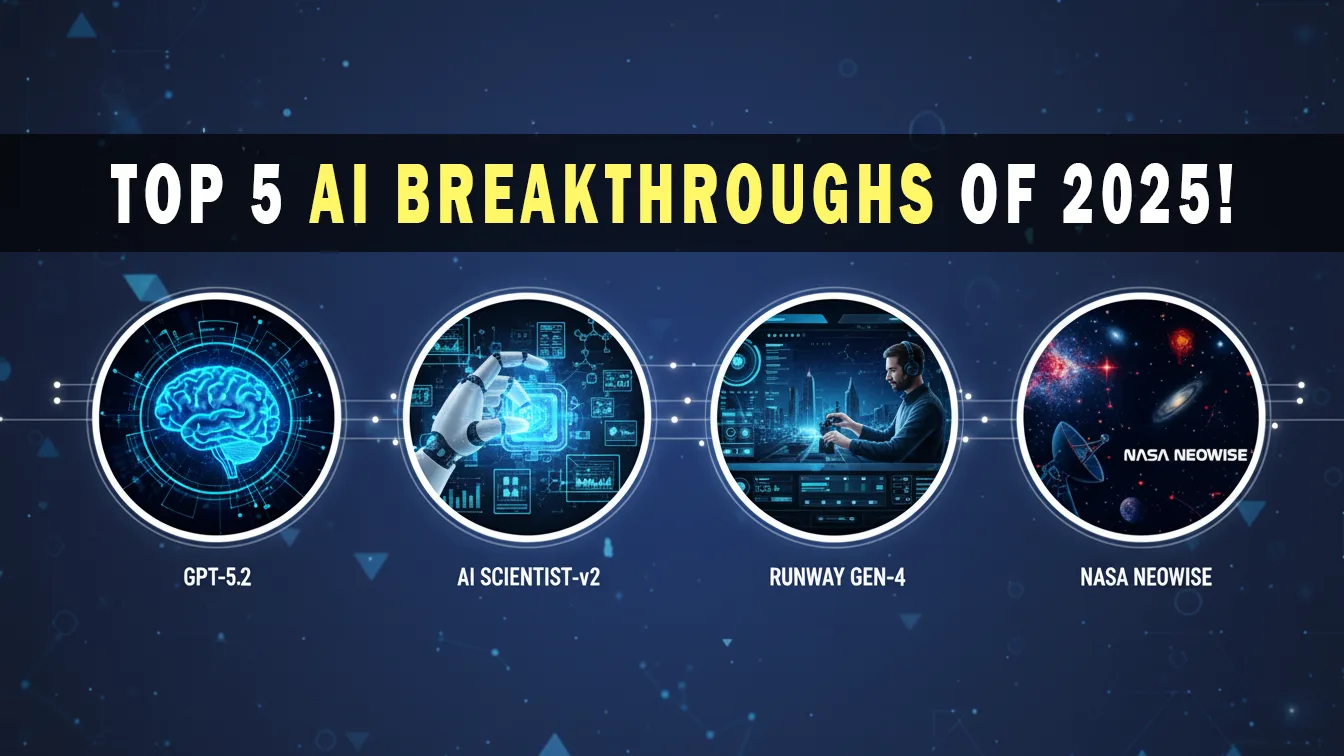
2025 became one of the most significant years for AI Breakthroughs, a year of transformation. Rather than just improving, AI shifted its focus and went into deeper areas of reasoning, scientific autonomy, evolutionary algorithm design, realistic video creation, and real astronomical discovery. AI systems in 2025 are no longer just digital assistants or automation tools; they actually started showing the ability to think longer, experiment independently, create more realistically and discover what humans couldn’t detect before.
Big corporations, research laboratories, and even independent innovators have put AI on the path of solving real, world problems at a huge scale. Whether it’s advanced reasoning models like GPT, 5.2, scientific research agents like AI Scientist, v2, evolutionary algorithm design like AlphaEvolve, hyper, real video generation via Runway Gen, 4 or AI, powered astronomy discoveries from the NASA datasets 2025 was the year of the shift from AI that chats to AI that performs, discovers, and creates.
We can take a look at the 5 biggest AI Breakthroughs that happened globally in 2025, supported by actual releases and official research developments.
OpenAI GPT, 5.2 Smarter Reasoning, Better Multimodal AI
OpenAI unveiled GPT, 5.2 in December 2025. This is a substantial upgrade of its generative AI family. The model featured stronger logical reasoning, improved abstract thinking, and better multimodal comprehension (image + text). Moreover GPT, 5.2 was presented in three significant variants:
- GPT-5.2 Instant → Fast, real-time responses
- GPT-5.2 Thinking → Longer reasoning mode for complex problems
- GPT-5.2 Pro → High-compute reasoning with extended context
With this redesign, the focus is more on enhanced accuracy, deeper analysis, better mathematical reasoning, and multi, input processing, which makes it one of the most powerful public LLM updates & AI Breakthroughs of 2025.
Why This Was a Big Deal Globally
- Improved reasoning led to less hallucinations and more accurate responses
- Multimodal ability helped users analyze text + images together
- Tiered modes allowed both speed and deep computation
GPT, 5.2 became a worldwide standard because it focused on improving core intelligence rather than simply increasing the number of parameters. It affected the areas of coding assistance, research, automation, financial analysis, creative writing, and AI tooling ecosystems that were spread across the globe.
Runway Gen, 4 AI Video Generation With Real Physics & Motion
Runway, a U.S. based generative AI company, released its Gen, 4 AI video model in 2025, marking a major step forward in text, to, video realism. Unlike earlier Gen, 3 or other competing video AI, Gen, 4 introduced:
- Characters were more consistent across the frames
- Motion was more realistic
- Realworld physics simulation was used in the video lighting, movement
- Environmental interaction were improved
- There was less jitter in the animations and the motion continuity was smoother
This model is now widely used by creators globally for short films, YouTube storytelling, ads, visual experiments, and cinematic concept content.
Why It Matters
- Film, like AI videos are now actually usable for creators
- Character continuity made AI videos less chaotic and more narrative, friendly
- Real physics simulation improved realism dramatically
2025 is remembered as the year of AI Breakthroughs when AI video stopped feeling like animation and started feeling like digital cinema and Runway Gen 4 played a key role in that shift.
AI Scientist, v2 AI That Conducts & Publishes Scientific Research on Its Own
A stunning breakthrough in research in 2025 was the development of AI Scientist, v2, an agentic AI research system that can:,
- Generate new scientific hypotheses
- Design experimental workflows
- Analyze scientific data
- Refine research based on results
- Write research papers for peer review
The system demonstrated autonomous research without the need for human scripting and had the manuscripts accepted on workshop tracks thus proving that AI can perform scientific cycles in reality, not only simulate them. This is definitely a AI Breakthroughs.
Global Significance
- Speeds up scientific discovery timelines worldwide
- Removes the repetitive manual planning of experiments
- AI can iterate research loops 24/7
AI Scientist, v2 did not only help scientists it digitally became a scientist itself thus opening a future where discoveries take less time because AI handles hypotheses, testing loops at scale.
AI in Astronomy 1.5+ Million Hidden Stars Identified Using AI

A student in late 2025 deployed AI to analyze the NEOWISE infrared sky dataset, part of NASA missions, and discovered more than 1.5 million new celestial objects that had not been identified before. NASA officials publicly recognized the find as a landmark moment in the use of AI for detecting patterns on an enormous scale in astronomy.
Why This AI Breakthroughs Was Huge
- AI could “read” space data much faster than any conventional method
- Made it possible to find very faint cosmic objects that humans had overlooked
- Demonstrated that AI can be a source of scientific insights from huge datasets
This achievement is a symbol of how AI is assisting humans to visualize the invisible in scientific data, and astronomy has become one of the best examples of AI powered discovery in 2025 & obviously is another AI Breakthroughs.
AlphaEvolve AI That Evolves and Optimizes Algorithms
AlphaEvolve is an evolutionary AI system that can generate, test, refine, and evolve computer algorithms automatically using performance feedback loops. Google DeepMind released it in May 2025.
Unlike normal LLM coding tools that generate code, AlphaEvolve goes further; it creates multiple algorithm variations and tests them to identify optimized versions.
Global Significance
- A breakthrough in computer science automation
- AI becomes a participant in algorithm design
- Improves software efficiency without human iteration
This AI Breakthrough changed how the world views AI in coding from a generator to an optimizer and innovator.
| AI Breakthrough | Domain | Global Contribution |
|---|---|---|
| GPT-5.2 | AI Reasoning & Multimodal | Smarter thinking and deeper context |
| Runway Gen-4 | AI Video | Real motion + physics-based cinematic visuals |
| AI Scientist-v2 | Science | Autonomous hypothesis testing & paper writing |
| NASA Star Discovery via AI | Astronomy | Millions of hidden stars identified |
| AlphaEvolve | Computer Science | AI-driven algorithm optimization |
To Sum Up, 2025 illustrates the transition of AI very clearly to real autonomy, creativity, and discovery beyond simple assistance. Smarter reasoning was made with a model like GPT, 5.2, while creative film workflows were opened to AI by Runway Gen, 4. AI Scientist, v2 demonstrated that AI is capable of doing research cycles in complete independence and as a result of this, several astronomical discoveries from NASA datasets evidenced that AI has the ability to find what humans overlook. AlphaEvolve revealed that AI coding through the use of evolutionary testing is capable of now only programming scripts but also optimizing algorithms.
What was the 2025 AI breakthrough that really shocked you? Would you permit AI to publish scientific papers on its own? And will 2026 be the year when AI replaces the traditional way of video production?
Let’s discuss it in the comments section! & Follow InsiderXP for More Updates!